
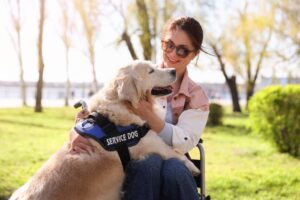
Good morning, all! Welcome back to another edition of the CertaPet newsletter. This week, we’re taking you to Rutgers University, New Jersey, where participants of the Disability Awareness Month are sharing their personal stories to promote awareness about the vital role that service animals have.
Participants Share Their Recovery Milestones With Service Animals During Events For The Disability Awareness Month
Two years ago, student veteran Nadia Elieff was searching for new ways to manage her PTSD when she attended a campus panel on service dogs. She soon learned she qualified for one, and the decision became transformative. Now, after a few months with her service animal, Truffle, she says her recovery looks entirely different.
“He provides me with so much support that I was missing before. He is the final puzzle piece to my recovery,” said Elieff (former Army Reservist who served five years), who is now completing a master’s degree in labor studies and employment relations at Rutgers University–New Brunswick.
Elieff will also be one of the speakers at “Unleashing Independence: The Vital Role of Service Dogs,” an annual panel held during Disability Awareness Month across more than 40 college campuses in the United States. She first discovered the program at this very event and now sees her participation as a way to pay that help forward.
Her PTSD stems from a sexual assault that occurred during her service. Although she remained committed to therapy and advocacy work on behalf of other survivors, her progress had stalled until she was matched with Truffle.
Almost immediately, she experienced a change in her confidence and nervous-system regulation. “Even with different treatments before, I was still afraid to go outside by myself. But he makes me feel more comfortable in public. I’ve gained a lot of the independence that I lost before because of how unsafe I used to feel in public spaces,” she said.
Truffle can create physical space around her by standing behind her in crowded lines. While in class, the dog can sense anxiety as it builds up within his handler. Elieff stated, “If he sees me tapping my leg in class or fidgeting, he’ll come up to me and put his head in my lap as a way of saying, ‘Hey, girl, you’ve got to figure this out. Stop doing that,” she said.
The Unleashing Independence panel will also feature Javier Robles, a Rutgers professor of kinesiology and Director of the Center for Disability Sports, Health, and Wellness. A C5 quadriplegic, Robles has worked with service dogs for decades and was recently paired with Gonzalo, his fourth dog from Canine Companions. “Fifty percent of dogs that go through the program do not make it for a variety of reasons, including reactions to certain environmental issues,” he said. “Nothing fazes Gonzalo, and that’s what you want.”
Professor Robles is advocating for more college campuses in the U.S. to become settings for service dogs’ professional and task-based training. The last two service dogs that Robles had were trained on university campuses, which is why they are so accustomed to dealing with large numbers of people, noises, smells, and much more. Robles also remarked that retired service dogs can go on to serve as therapy animals in designated facilities, thus continuing to positively impact people’s lives.
What is disruptive and harmful to the disability community, he noted, is the increase in fake online services that claim to qualify dogs as service animals, thereby granting them public access rights. However, when animals have not undergone the appropriate training, they pose a threat and an issue to the general public.
Source: Rutgers
CertaPet’s Thoughts on This Week’s News
Events like Disability Awareness Month at Rutgers help promote wider access and deeper understanding for those still waiting to reclaim their independence through assistance animals. Elieff’s and Robles’s stories showcase the vital importance of service dogs for both visible and invisible disabilities and highlight the need for more certified and qualified training facilities to ensure that more people can gain access to these life-changing animals.
Getting a Psychiatric Service Dog (PSD) as part of your treatment care plan has never been easier. If you’re living with emotional or mental health challenges, a PSD could ease your symptoms and help you live a happier, fuller life. If you’re ready to start the process, take our 5-minute pre-screening test for free. We’ll connect you with a licensed mental health professional, who will have a consultation with you. Then, if you qualify, you’ll get your PSD letter in no time.