
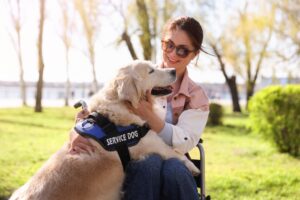
Good morning, readers! This week’s CertaPet newsletter has some exciting information. A new study published in ‘Behavioral Sciences’ reveals that interaction with service dogs can benefit individuals not just psychologically but also on a cellular level. Read on to learn more.
Man’s Best Friend Can Help Women Veterans Heal and Possibly Turn Back The Clock
A new study suggests that service dogs might play a surprising role in slowing biological aging, particularly in women. The pioneering research, conducted among female US veterans, is one of the first of its kind to examine how training service dogs affects stress and cellular health in an often-overlooked population. The study also led to a startling revelation – that emotional stress doesn’t always align with how the body experiences it on a cellular level.
Women have served in the U.S. military for decades, and their representation and responsibilities have expanded dramatically since 1948. Despite this, research on military-related stress focuses largely on men, even as women report higher rates of post-traumatic stress disorder (PTSD).
Researchers from Florida Atlantic University collaborated with the University of Maryland School of Nursing, the Medical College of Georgia, and Warrior Canine Connection, Inc. to address the aforementioned gap. Their study concerned female veterans with PTSD who volunteered to train service dogs for fellow veterans, a task designed to help others while potentially benefiting the trainers themselves.
Funded by the National Institutes of Health’s Eunice Kennedy Shriver National Institute of Child Health & Human Development, the study investigated whether this purposeful, mission-driven activity could lower both biological and psychological stress, and how combat experience might influence those effects.
Researchers measured biological stress through telomere length (an indicator of cellular aging) via saliva samples, and heart rate variability (HRV) using wearable monitors. Besides that, psychological factors such as PTSD symptoms, anxiety, and perceived stress were tracked through validated questionnaires throughout the eight-week program.
The findings, published in Behavioral Sciences, were unexpected. Participants who trained service dogs showed increased telomere length, suggesting slower cellular aging, while those in the control group (who only watched dog-training videos) showed telomere shortening.
Veterans with combat experience saw the most prominent biological benefits from the dog-training program. In contrast, mental health improvements such as reduced PTSD and anxiety appeared across both groups, suggesting that participation alone offered therapeutic value.
According to lead author Cheryl Krause-Parello, Ph.D., “This research underscores the power of service dog training as a meaningful, non-pharmacological intervention to support the health and healing of female veterans with PTSD.”
The study also shows that the skills gained, like positive reinforcement and reading animal behavior, might even strengthen bonds with personal pets, extending the emotional impact beyond the program itself. These early results highlight the potential of animal-assisted, nontraditional therapies to help female veterans manage stress, support emotional recovery, and possibly slow biological aging.
Source: News Medical
CertaPet’s Thoughts on This Week’s News
Programs like service dog training can provide a valuable, non-pharmacological path to healing by promoting emotional connection, reducing stress, and potentially slowing biological aging. Beyond the female veterans, these findings may inspire a broader use of animal-assisted interventions to promote well-being in other high-stress populations, which is definitely good news all around.
Getting a Psychiatric Service Dog (PSD) as part of your treatment care plan has never been easier. If you’re living with emotional or mental health challenges, a PSD could ease your symptoms and help you live a happier, fuller life. If you’re ready to start the process, take our 5-minute pre-screening test for free. We’ll connect you with a licensed mental health professional, who will have a consultation with you. Then, if you qualify, you’ll get your PSD letter in no time.